
Generated Artwork Source and Review Records
A polished AI image is not yet a reviewable commercial asset. Before it enters a sticker sheet, decal set, clipart bundle, mockup, or marketplace listing, its source record should show how it was made, what else it contains, and which questions remain open.
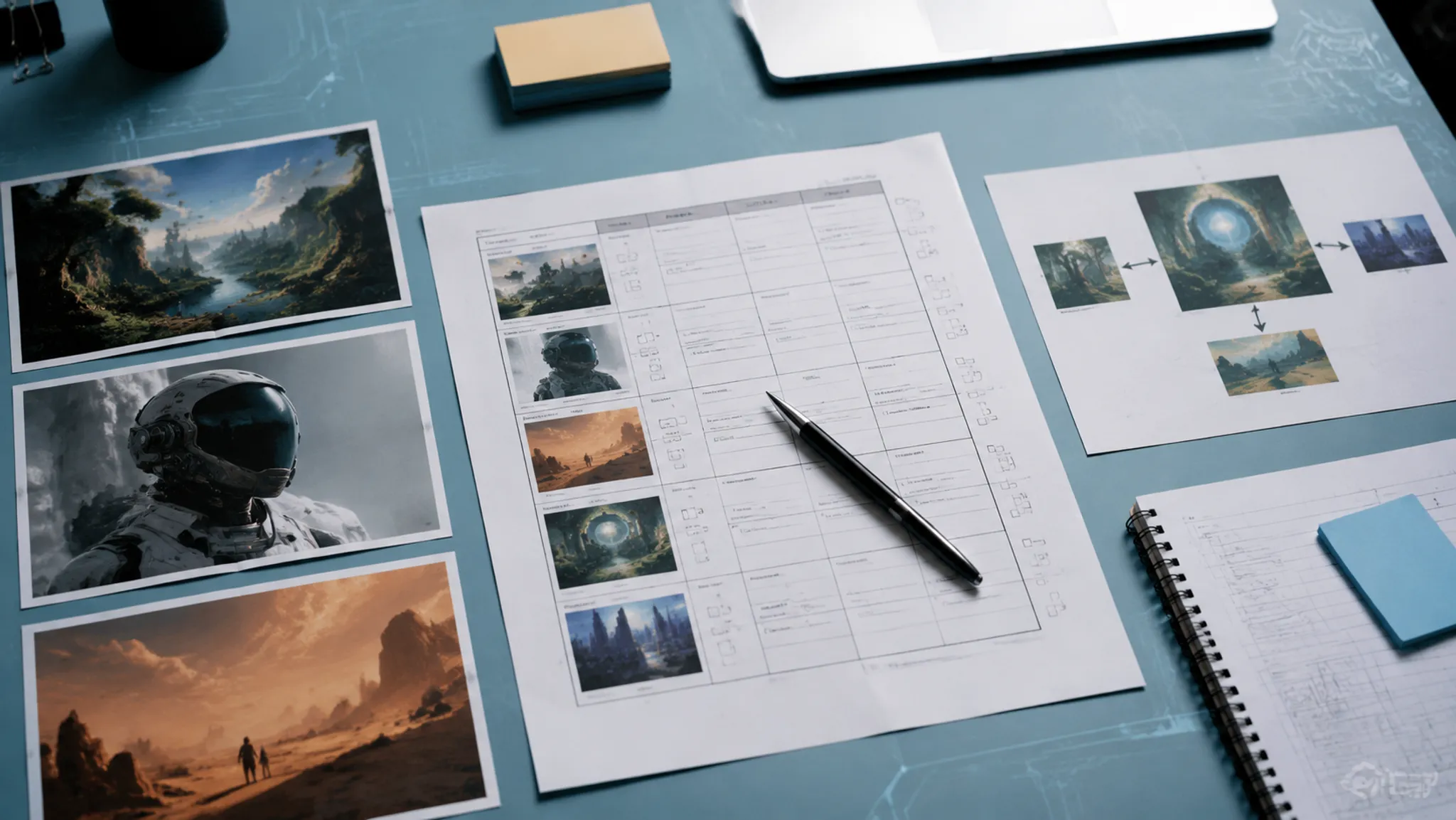
For creators assessing AI art commercial use, the useful starting point is not a single ownership label. It is a record that separates four checks:
- What the platform or product terms state
- What happened during generation and editing
- What other source material appears in the asset
- What remains to be confirmed under applicable copyright or marketplace rules
These checks overlap, but they do not answer the same question. A source record can preserve the review basis. It cannot certify legal clearance, registration eligibility, resale permission, or marketplace acceptance.
More specific pages
These pages continue the topic in smaller, more specific directions.
What an AI Artwork Provenance Sheet Should Record
An AI artwork provenance sheet is a structured record for one asset or one clearly defined production item. It should be specific enough that another reviewer can understand the asset chain without relying on memory.
For each generated image, record:
- Asset name or internal identifier
- Generation platform or creative product
- Model, feature, or product context when shown by the service
- Account or workspace context
- Generation date
- Prompt or workflow notes, where retention is appropriate
- Selected output and relevant variation history
- Human edits made after generation
- Other source material added to the asset
- Permissions or licenses for non-AI inputs
- Applicable platform terms
- Terms access date or terms update date reviewed
- Unresolved copyright or third-party rights questions
- Review status and reviewer notes
The generation date matters because platform terms and product conditions may change. Record the terms page or product terms that were checked, then add the date on which you accessed or reviewed them.
A short note such as “made with AI, commercial use allowed” collapses several separate judgments into one phrase. It does not show which product was used, which account conditions applied, whether the asset includes outside material, or whether the statement concerns contractual permission rather than copyright treatment.
Keep Three Evidence States Separate
A practical AI artwork review record should distinguish what a provider states, what the production history documents, and what still depends on an independent rule or review.
Stated in the platform terms
This category covers what a provider says about its own service, product, account conditions, output-use provisions, or restrictions. OpenAI Terms of Use and Adobe Legal Terms can support source-specific checks of this kind.
Record the exact product and account context. A statement associated with one service, plan, region, or workflow should not be generalized to every AI tool.
Use wording such as “The applicable product terms state that...” The phrasing identifies the source of the claim while leaving room for conditions, exclusions, changes, and jurisdiction-specific interpretation.
Documented in the source record
This category covers what your own record shows:
- The tool used and the account or workspace context
- The generation date and selected output
- The human edits and selection decisions
- The imported source material
- The sequence of revisions
- The unresolved questions
These are provenance facts about the asset’s production history. They may help another person inspect the work, but they do not automatically establish ownership or permission.
Independently established
This category concerns questions that depend on applicable law, marketplace requirements, or the current rules of a relevant service. The U.S. Copyright Office provides a U.S.-specific reference point for copyright and registration questions involving human contribution and AI-generated material.
That reference does not turn every AI artwork record into a universal answer. Copyright treatment may depend on jurisdiction, human contribution, the nature of the resulting work, and the specific question being asked.
Keep this category visible in the sheet. Useful fields include:
Independent status: unresolvedJurisdiction checked: United StatesCurrent rule confirmed: noEscalation needed: yes
A record that preserves uncertainty is more useful than one that assigns a confident status without showing its basis.
Record Human Contribution Without Turning It Into a Legal Conclusion
“AI-generated” and “human-made” are often treated as opposing labels, but a mixed process can include several kinds of human contribution.
Record the contribution in observable terms:
- Prompt development
- Selection between variations
- Cropping or compositional changes
- Manual drawing or painting
- Redrawing of details
- Typography or lettering work
- Color and contrast adjustments
- Background removal
- Layout decisions
- Combining multiple assets
- Cleanup around the outline or cut edge
- Final export preparation
Do not convert a long edit list into an automatic copyright conclusion. The record should describe what the person actually chose or changed.
Research discussed in the ACM Designing Interactive Systems paper supports preserving iteration history, configuration context, randomness where relevant, chronology, and human creative decisions as useful documentation. That research explains why these fields may be worth keeping; it does not establish the legal result for a particular asset.
A useful contribution note might read:
The selected output came from a generated variation. The creator then redrew the facial details, changed the color system, removed the background, and combined the result with separately licensed lettering.
This is more reviewable than “AI-assisted with human input.” It shows which parts require closer inspection and which parts may come from another source.
Review Each Asset Separately in a Mixed-Source Pack
A mixed-source asset pack may contain generated images, hand-drawn motifs, licensed clipart, stock elements, fonts, textures, logos, and customer-supplied material. The collection should not receive one broad rights status simply because the assets appear together on a sheet.
For every item, identify:
- The primary source
- Any additional source material
- The terms or license connected to each source
- Human changes made to the item
- Third-party rights questions
- The current review status
The same pack may contain one generated motif with documented platform terms, one licensed texture with an attribution condition, and one imported logo awaiting permission confirmation. A collection-level label hides those differences.
The same rule applies to supporting motifs. An anchor motif may be generated, while a small border, phrase, symbol, or decorative texture comes from somewhere else. Inspect the complete asset, not only its most visually prominent element.
Example asset record
| Field | Example entry |
|---|---|
| Asset ID | camping-mug-03 |
| Primary source | AI image product, product name recorded |
| Account context | Individual account, workspace status recorded |
| Generation date | Date recorded in the project log |
| Selected output | Variation 4 |
| Human contribution | Selected variation, redrew handle, adjusted colors, removed background |
| Other source material | Licensed lettering added separately |
| Applicable terms | Product terms reviewed |
| Terms review date | Date accessed |
| Third-party rights | Lettering license retained; recognizable source resemblance unresolved |
| Review status | Hold for visual and rights review |
This is a documentation pattern, not evidence that the asset is cleared for sale.
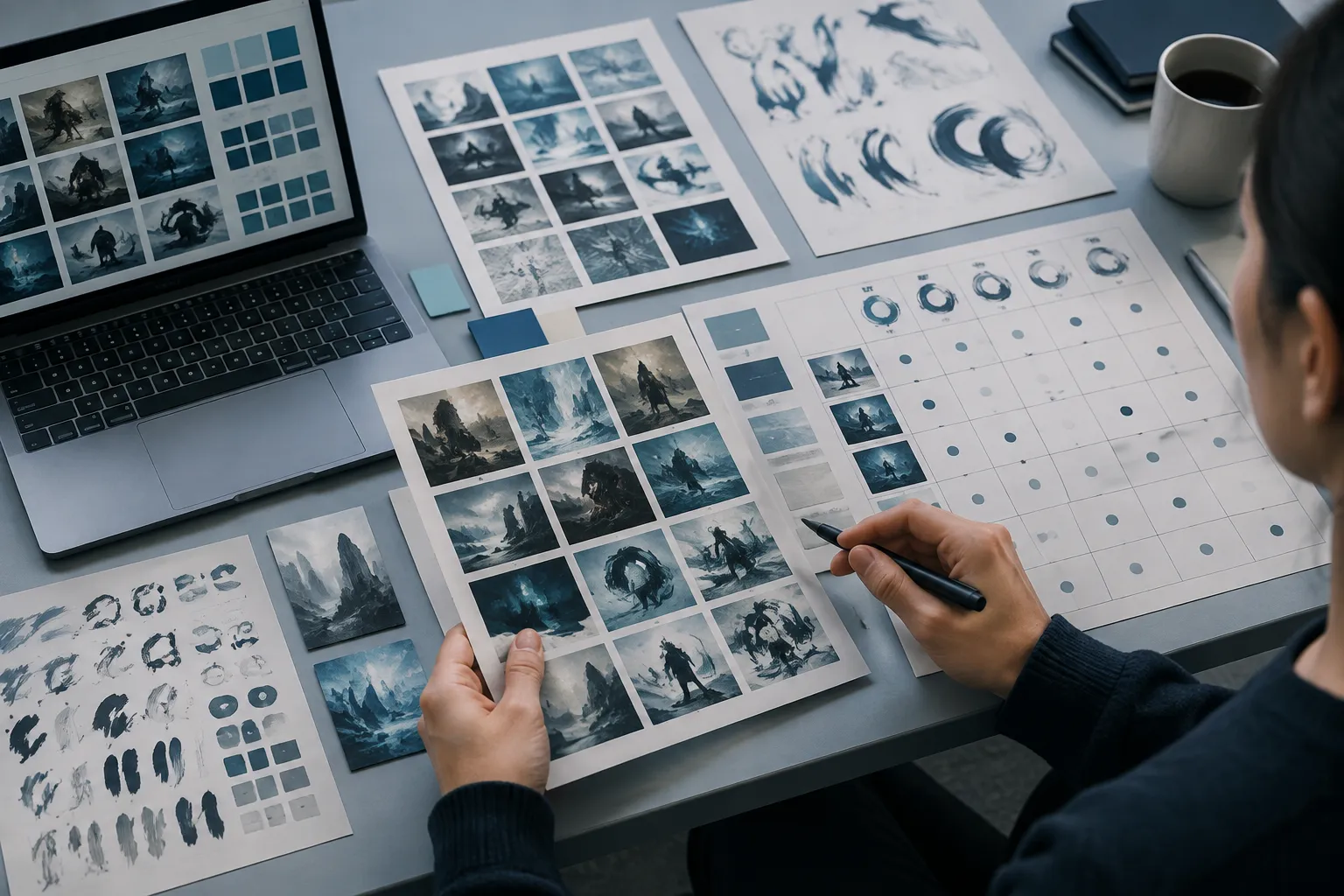
Platform Terms Are One Check, Not the Whole Answer
Commercial-use language can be easy to overread. A provider may describe how users can use outputs under its service terms, but that language belongs to a particular product and contractual context.
It does not automatically settle:
- Copyright registration eligibility
- Rights in third-party source material
- Whether a result resembles protected expression
- The effect of local law
- Marketplace disclosure or content rules
- Permission for imported fonts, images, logos, or textures
- Whether a later edit changes the relevant analysis
Record the platform terms separately from the copyright question. A useful sheet might contain two different fields:
Platform permission stated:record the provider’s applicable wording and dateCopyright treatment:unresolved; depends on jurisdiction and human contribution
When a listing description uses broad phrases such as “commercial rights included,” preserve the commercial language as a record of what was stated. Also identify who stated it, which product and account conditions applied, and when the wording was reviewed.
Check the source terms again when the product, account type, generation workflow, or intended distribution changes.
Keep the Generation Date Beside the Terms Review Date
The AI artwork generation date is useful only when it can be compared with the applicable terms history.
Record:
- When the image was generated
- When the terms were reviewed
- Whether the terms page showed an update date
- Which product or feature was covered
- Whether the current terms clearly applied to the original generation
If the generation date is known but the terms review date is missing, the record has a timing gap. If the terms update date is known but the product or account context is missing, the record has a scope gap.
Use a status such as “needs terms verification” rather than filling either gap with an assumption. The applicable terms may depend on the product, account, location, plan, or workflow.
Give Third-Party Rights Their Own Review Pass
AI artwork copyright questions are not limited to the person who generated the image. A pack may also raise questions about source material, recognizable expression, logos, names, lettering, characters, or imported design elements.
The review record should include a third-party rights field with enough detail to support follow-up:
- Whether outside material was used
- Where that material came from
- The stated license or permission
- Any attribution condition
- Whether the source terms permit the intended format
- Whether recognizable protected expression remains a concern
- Whether the question has been resolved
Do not treat visual similarity, shared style, and recognizable protected expression as identical categories. They may require different review paths, and the available material does not support a universal threshold for every asset.
A generated concept can look original while still requiring closer inspection. Conversely, a common subject or genre does not by itself establish that an asset copies a specific protected work. Record the observation and the unresolved question without presenting either as a final legal finding.
Use Review Statuses That Preserve Uncertainty
A binary “approved” or “rejected” label is often too blunt for a mixed-source workflow. Use statuses that show what has been checked and what still blocks the next step.
Intake:source information is incompleteTerms check pending:product, account, or terms details need reviewSource review pending:outside material has not been documentedHuman contribution recorded:edits and selection decisions are documentedVisual review pending:the asset still needs inspection at intended scaleHold:an unresolved rights or source question blocks listing or productionReady for next review:the current record is complete, but final production or marketplace checks remainArchived:retained for reference but not scheduled for use
These labels describe workflow state. They do not certify commercial rights or marketplace acceptance.
A polished mockup should not move an asset directly to a final status. A mockup can show how a sticker, decal, or clipart pack might appear in context, but it does not prove that the export, cut edge, source record, or listing conditions have been confirmed.
A Review Pass for Commercial AI Artwork Records
The recordkeeping process works best as a sequence of dependent checks.
1. Establish the asset boundary
Decide what is being reviewed: one sticker, one clipart file, one decal graphic, or a complete composite. Save the asset identifier and the version under review.
If the file contains several motifs, separate them where their sources or edits differ.
2. Capture the generation context
Record the platform or product, account or workspace context, generation date, and workflow notes. Preserve the selected output and relevant iterations where practical.
The record should make clear whether the final asset came directly from one output or from several generated and non-generated elements.
3. Document human contribution
Describe selections, edits, redraws, layout decisions, cleanup, and export changes. Use concrete verbs such as selected, removed, redrew, combined, adjusted, and exported.
A contribution label is not a substitute for the underlying description.
4. List every additional source
Add fonts, textures, stock elements, logos, customer files, licensed clipart, and other imported material. Attach the stated permission or license information to the specific source rather than to the pack as a whole.
5. Check the applicable terms
Review the product terms connected to the actual generation context. Record the terms location or document name, access date, update date when shown, and any condition affecting intended use.
The source terms state one part of the review. They do not answer every copyright or marketplace question.
6. Mark unresolved questions
Keep third-party rights, jurisdiction, human contribution, recognizable expression, product terms, and marketplace requirements visible when they remain open.
Do not replace an open question with a reassuring label.
7. Route the asset to the next dependency
Only after the provenance record is coherent should the asset move to format-specific inspection, production preparation, or listing review. At that stage, inspect transparency, resolution, outline behavior, cut-edge clearance, and thumbnail readability according to the intended format and provider requirements.
The provenance record supports those later checks, but it does not replace them.
What Metadata and Audit Trails Can and Cannot Do
Metadata, hashes, content credentials, and other provenance mechanisms may help preserve chronology or show that certain information was attached to a file. The EKILA research offers one technical example of synthetic-media provenance and attribution work.
These mechanisms can improve traceability. They do not independently prove:
- Ownership
- Permission to use third-party material
- Copyrightability
- Commercial clearance
- Marketplace acceptance
- Accuracy of every recorded claim
For a small asset pack, a clear human-readable record may be more useful than a complex infrastructure layer. If machine-readable metadata is used, treat it as an additional record, not a replacement for source terms, edit notes, and unresolved questions.

Common Mix-Ups in AI Art Commercial Use
“The platform allows commercial use, so the image is protected.”
Platform permission and copyright treatment are separate questions. The first concerns stated service conditions; the second may depend on jurisdiction and human contribution.
“The creator edited the prompt, so every output is human-authored.”
Prompting may be one part of the process. Record the prompt and the later selection, editing, and composition decisions without assuming that one field settles the result.
“The whole pack has one status.”
A mixed-source asset pack can contain different source conditions and unresolved questions. Review each asset separately.
“A provenance sheet proves the rights.”
A provenance sheet documents the review basis and production history. It does not certify legal clearance.
“A polished mockup proves the asset is ready.”
A mockup is preview evidence. Production evidence still depends on the export, intended scale, material, cutting process, and relevant service requirements.
Frequently Asked Questions
What should an AI artwork provenance sheet include?
At minimum, record the platform or product, account or workspace context, generation date, selected output, applicable terms, terms review date, human contribution, other source material, permissions, unresolved questions, and review status.
Should I record every prompt?
Record enough prompt or workflow information to explain the generation history and support later inspection. The level of detail depends on the project, privacy considerations, and the record’s intended use. Preserve iterations when they materially explain selection or human contribution.
Does a platform’s commercial-use wording answer AI artwork copyright questions?
No. It records the provider’s stated contractual position for a specific product and context. Copyright questions may depend on jurisdiction, human contribution, and the nature of the resulting work.
How should I handle a mixed-source asset pack?
Create an asset-level record for each item with a different source, edit history, or rights question. Then create a collection summary that points to those individual records instead of assigning one broad status.
What does the U.S. Copyright Office source establish here?
It supplies a U.S.-specific boundary for questions involving AI-generated material, human contribution, and registration. It should not be presented as a universal rule for every jurisdiction or marketplace.
Can metadata prove commercial permission?
No. Metadata can help document chronology, source information, or attribution fields. Commercial permission still depends on the applicable terms, licenses, rights checks, and marketplace requirements.
When should an asset remain on hold?
Keep it on hold when the source material is undocumented, applicable terms are unclear, human contribution is not recorded, third-party rights remain unresolved, or the intended marketplace requires a check that has not been completed.
The Working Standard
A defensible AI artwork review record does not need to pretend that every question has one answer. It needs to show which answer comes from platform terms, which facts come from the production history, and which issues still depend on applicable law or marketplace rules.
For each asset, record the source, date, account context, terms, human contribution, other inputs, and unresolved questions. For each mixed-source pack, inspect the items separately. Then route the reviewed asset to the next format, production, or listing check without treating a generated preview as final evidence.
That is the practical boundary between an AI image that merely looks finished and a commercial asset whose review history can be inspected.