
Commissioned and Collaborator Asset Records
An art commission contract can define the project without showing a later reviewer which approved artwork was delivered. A collaborator may revise an anchor motif, replace a source element, or export a new file after approval. Without a connected record, “approved,” “final,” and “delivered” can describe different states.
A commissioned artwork handoff record keeps those states traceable. It connects the agreed scope, approval evidence, revision history, source and usage terms, approved artwork version, and delivered file inventory in one reviewable lane.
This record is an editorial workflow aid, not a replacement for the governing agreement or a determination of rights. Its fields are practical examples. Their suitability depends on the project, the parties, the intended format, the applicable terms, and any later professional or jurisdiction-specific review.

More specific pages
These pages continue the topic in smaller, more specific directions.
What the Record Needs to Connect
A useful record should let another reviewer answer five related questions:
- What was agreed?
- What was approved?
- What changed during revision?
- Which source and usage terms apply?
- Which files were delivered at handoff?
These questions should not be collapsed into one status label. An approved preview can identify a visual composition. A contract or license can state terms. A delivered export can show file properties. Each evidence layer answers a different question.
For a sticker pack, the record might cover an anchor motif, supporting motifs, individual die-cut files, a sticker-sheet layout, and digital clipart exports. A decal collection may also need separate entries for artwork files, cut-line files, and listing images. A collaborator’s contribution should remain identifiable rather than disappearing into a single “final” folder.
A proposed record may include:
- Project identifier and collaborator roles
- Agreed art commission deliverables
- Intended collection or product format
- Approval checkpoints
- Revision requests and decisions
- Approved artwork version
- Source and license references
- Stated artwork usage terms
- Commissioned artwork file inventory
- Delivered artwork filenames and export details
- Unresolved artwork handoff exceptions
- Handoff date and confirmation status
The field names can vary. The connection between them is what makes the handoff reviewable.
Start With the Agreed Scope
Begin with the scope stated in the art commission contract or related written agreement. Record what the project was expected to contain before evaluating later files.
For a themed sticker collection, an example scope entry could identify:
- The collection theme and planned motif family
- The number and type of motifs
- Whether the work includes individual stickers, a sheet layout, or both
- Whether layered working files are included
- Whether transparent exports are expected
- Which collaborator supplies or modifies particular motifs
- Which deliverables are previews rather than final exports
This does not interpret the agreement. It creates a pointer back to the wording that governs the project.
| Record area | Example entry |
|---|---|
| Collection deliverable | Themed sticker pack with individual motif exports |
| Layout deliverable | One sticker-sheet preview and one layout export |
| Collaborator contribution | Supporting botanical motifs and two decorative borders |
| Excluded item | Early alternate lettering concept |
| Open condition | Export format to be confirmed against the selected service |
The open condition should remain visible. An unresolved production detail should not be silently converted into a completed deliverable.

Record Artwork Approval Evidence
Approval evidence should identify what was approved and show another reviewer where to find it. A message that says “looks good” may be meaningful in context, but it is difficult to review without an associated preview, version identifier, or filename.
An artwork approval entry could record:
- Approval checkpoint and date
- Person or role giving approval
- Preview filename or reference
- Artwork version identifier
- Motifs or layout covered
- Requested changes still open
- Approval status
- Related delivered file, if known
Keep the status narrow. “Approved preview for color direction” differs from “approved final export.” “Approved sticker-sheet composition” differs from “approved production file.” The wording should describe the event recorded, not imply that every later file property was accepted.
A mockup may show arrangement and general appearance while leaving transparency, resolution, color behavior, cut-edge spacing, or export format unresolved. Treat that visible evidence separately from the file checks that depend on the intended format and current service requirements.
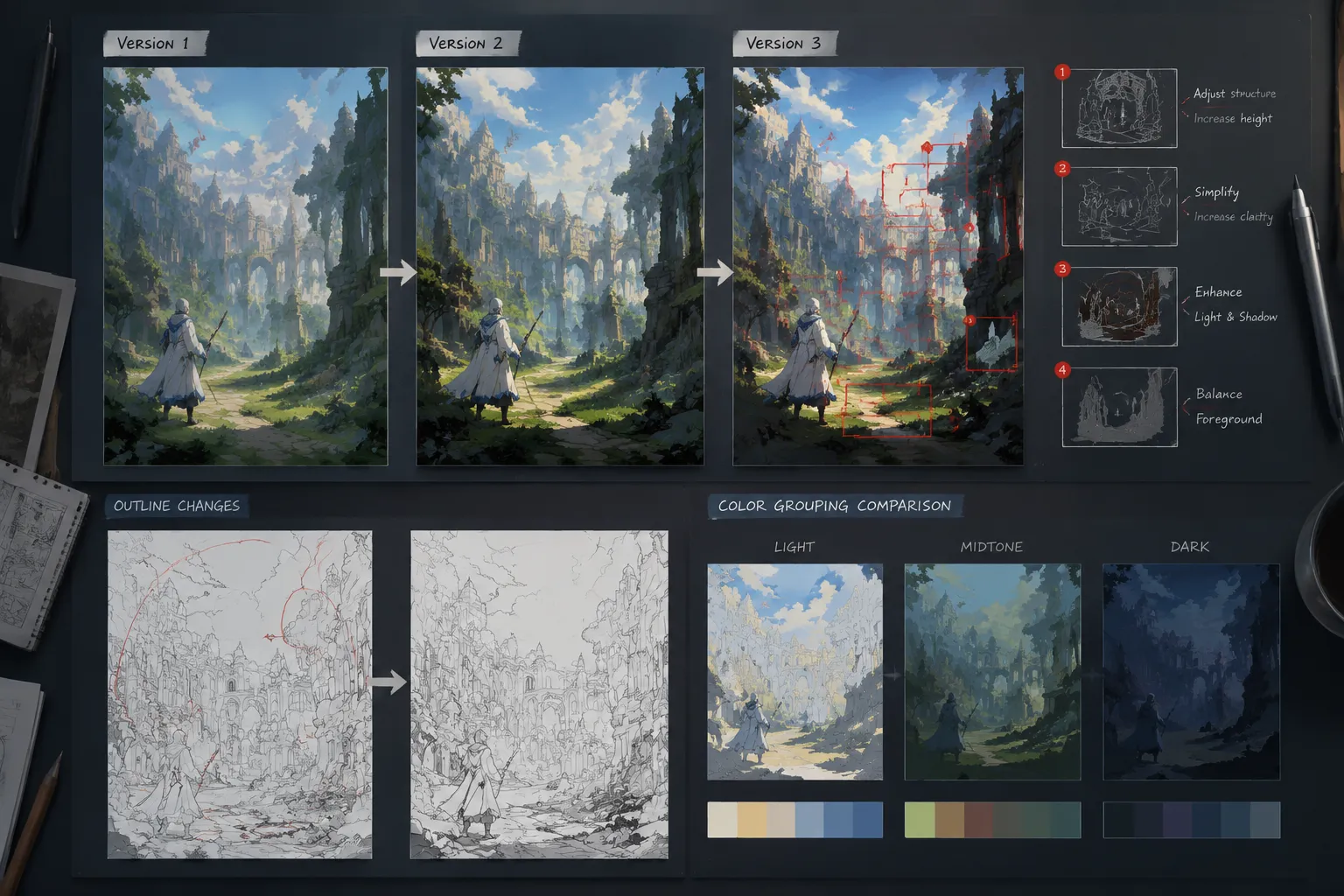
Keep an Art Commission Revision History
A revision history shows how the approved version was reached. It does not need to preserve every informal exchange, but it should identify changes that affect the asset record.
| Version | Visible change | Decision or request | Status |
|---|---|---|---|
v01 | Initial anchor motif and supporting motifs | Review requested | Superseded |
v02 | Outline weight and border spacing revised | Revision requested | Superseded |
v03 | Color grouping and motif placement updated | Preview approved | Candidate approved version |
v04 | Exported files prepared from v03 | Handoff review | Delivered or exception pending |
These identifiers are examples, not a required naming standard. Their purpose is to distinguish versions that may otherwise look nearly identical.
A later export can preserve the same visible artwork while changing file properties. Record the visual revision and export revision separately when they differ:
- Artwork revision:
v03 - Individual export set:
v03-export-a - Sticker-sheet layout:
v03-sheet-b - Corrected transparency export:
v03-export-c
This relationship makes the correction visible. A newer date or filename alone should not decide which artwork is the approved version.
Match the Approved Version to the Delivered File
The central handoff check is a direct comparison between the approved artwork and the delivered export. Inspect them together and compare the parts that matter for the intended format:
- Anchor motif silhouette
- Supporting motif placement
- Outline and border treatment
- Color grouping
- Lettering or decorative details
- Number of included assets
- Transparent areas
- Visible crop or cut-edge spacing
- Sheet layout, where applicable
Record the result against an identifiable version or filename. For example:
Delivered
forest-pack-v03-sheet.pngmatches the approvedforest-pack-v03-previewfor motif placement and outline treatment. Transparency and service-specific export requirements remain to be confirmed.
That entry records observable continuity without extending into a rights or production conclusion. A matching filename is weak evidence by itself because two files can share a naming pattern while containing different artwork, transparency, or crop behavior.
Separate Source Records From Usage Terms
Source status and usage terms belong in the same handoff record, but they should remain separate fields.
A source record may identify:
- The source asset or contributor
- Where the source came from
- The source filename or identifier
- When the source was obtained or recorded
- The relevant license or source-term reference
- Any attribution or modification condition stated in those terms
- Whether the source status is confirmed, pending, or unresolved
Usage terms should record what the governing terms state about the intended use. An example might distinguish sticker production, decal production, digital clipart distribution, marketplace listing imagery, packaging or promotional use, derivative modification, and attribution notes.
Do not collapse these questions into a label such as “commercial use approved.” An art commission contract, source license, collaborator agreement, or platform term may address different rights and obligations. The handoff record can point to those documents and preserve their stated scope; it does not expand that scope.
Payment, file possession, or an approval message should not be treated as automatic evidence of ownership transfer, unrestricted use, or license scope. Where the wording has legal consequences, confirm the governing terms and seek qualified professional interpretation when needed.
Build the Commissioned Artwork File Inventory
The file inventory makes the handoff concrete. List what was delivered, what each file represents, and what remains unresolved.
| Delivered filename | Asset role | Version | Format | Transparency | Review status |
|---|---|---|---|---|---|
garden-pack-v03-sheet.png | Sticker-sheet layout | v03 | PNG | Observed in export | Reviewed |
garden-pack-v03-flower-01.png | Individual motif | v03 | PNG | Observed in export | Reviewed |
garden-pack-v03-border.ai | Editable border artwork | v03 | Editable source | Depends on file inspection | Pending |
garden-pack-v03-preview.jpg | Listing or review preview | v03 | JPEG | Not a transparent production export | Preview only |
Separate previews, editable source files, flattened exports, cut-line files, and listing images. A polished preview may support presentation while remaining unsuitable for cutting or digital distribution.
Record dimensions, color mode, resolution, transparency, and export format when they are shown in the file or tied to current documentation. Exact requirements depend on the printer, marketplace, service, material, or device involved.
For a sticker or decal pack, inspect whether the artwork reads at the intended display size, whether the outline holds together, and whether spacing is measured from the intended cut edge where that format requires it. These are format-dependent checks, not universal acceptance statements.

Use Approval Checkpoints to Expose Dependencies
Approval checkpoints reduce the chance that a later collaborator works from the wrong version. They also isolate exceptions when one part of the handoff changes.
- Scope: Confirm the agreed motifs, formats, and included deliverables.
- Concept: Review the theme, motif family, silhouettes, and collection structure.
- Revision: Record requested changes and identify the version receiving them.
- Artwork: Compare the approved composition with the named artwork version.
- Export: Inspect delivered files and their visible properties.
- Handoff: Mark each file as accepted, pending, replaced, or unresolved.
This is an example workflow, not a required procedure. Some projects may combine concept and artwork review. Others may need separate checkpoints for collaborator contributions, source terms, and production exports.
The dependency should remain explicit: an export review cannot confirm that the correct artwork was delivered until the approved artwork version is identifiable.
Write Handoff Exceptions in Observable Terms
A record becomes more useful when it preserves uncertainty instead of hiding it. Common exceptions include:
- The approval refers to a preview that was not delivered.
- The delivered filename does not identify an artwork version.
- A collaborator supplied a motif without a recorded source reference.
- The agreement lists a sheet but not individual exports.
- A final export differs from the approved preview.
- Transparency was expected but is not visible in the export.
- A listing mockup was approved, but production files were not reviewed.
- A source term is referenced without recording its applicable scope.
- A revised file was delivered after approval without a new checkpoint.
- The inventory lists a file that cannot be located.
State what is missing before assigning the next review. “Source reference is not connected to collaborator motif leaf-02; usage scope remains unresolved” is more useful than a general request for legal review.
Likewise, “Delivered sheet includes a revised border not visible in the approved preview; approval status for this change is unresolved” points to a specific comparison and decision.
Common Mix-Ups
Contract terms versus approval evidence
The contract may state the agreed deliverables. Approval evidence may show that a particular preview was accepted. Neither record should be assumed to answer the other question.
Approved artwork versus final export
An approved artwork version identifies a visual state. A final export identifies a delivered file. The export still needs comparison against that state and inspection against the intended format.
Source status versus usage permission
A source record identifies where an element came from. Usage terms describe what the applicable terms state. Recording the source is not the same as confirming unrestricted use.
Preview quality versus production evidence
A mockup can show hierarchy, placement, and appearance. It does not by itself establish that an export matches a printer, cutter, marketplace, service, or material requirement.
Ownership language versus file possession
Having a file, paying an invoice, or receiving an approval message does not by itself establish copyright transfer or unrestricted rights. Keep rights language tied to the governing terms.
Complete the Review Pass
Before marking a final artwork handoff complete, compare the record against these questions:
- Is the art commission contract or governing agreement identified?
- Are agreed deliverables listed separately from optional concepts?
- Does each approval checkpoint name the artwork it covers?
- Can the approved artwork version be matched to a delivered file?
- Are revision requests connected to the versions they changed?
- Are collaborator contributions identifiable?
- Are source and license references recorded separately from visual approval?
- Are stated usage terms distinguished from editorial assumptions?
- Does the file inventory list every delivered asset by filename?
- Are preview files separated from editable and production-oriented files?
- Are export details shown in the file or tied to current requirement documentation?
- Does the delivered artwork match the approved composition?
- Are thumbnail readability, outline behavior, and cut-edge clearance checked for the intended format?
- Are unresolved artwork handoff exceptions written in specific terms?
The decisive test is traceability. Another reviewer should be able to move from the agreed scope to the approval event, from that event to the exact version, and from that version to the delivered file without guessing.
That continuity makes a handoff easier to review. It does not replace the art commission contract, source terms, or format-specific requirements. It shows where the records agree, where file evidence is incomplete, and which decision still needs confirmation.